Helping couples trade wedding-day panic for wedding-day presence—one issue at a time.
The florist has the ceremony beginning at four.
The photographer’s timeline says four-thirty.
The DJ was told the wedding party will enter from the patio. The venue manager expects them through the ballroom doors. The caterer plans to serve dinner immediately after introductions, but the couple scheduled a private room reveal during that same fifteen-minute window.
Every one of these vendors may be talented, experienced, and completely prepared.
They are simply prepared for different weddings.
This is one of the quietest ways an event plan breaks down. Nothing is necessarily missing. The information exists—but it lives in separate emails, old contracts, private text threads, planning portals, screenshots, and different versions of the timeline.
The couple knows what the wedding is supposed to feel like because they have been living inside the plan for months.
The vendors only know what someone has told them.
Your vendors aren’t mind readers.
They cannot execute a decision they never received, follow a revision they never saw, or protect a priority nobody explained.

The Cherry Principle™
A plan becomes useful only when the people responsible for carrying it out receive the right information at the right time.
Communication is not the decorative ribbon tied around a finished wedding plan. It is the mechanism that makes the plan move.
A beautifully formatted timeline sitting unopened in someone’s inbox does not coordinate an event. A seating chart the caterer never received cannot guide meal service. A private conversation about family dynamics cannot help the photographer arrange portraits unless the relevant information reaches them appropriately.
Planning decides what should happen.
Communication makes sure the right people know how to make it happen.
Excellent Vendors Still See Different Parts of the Wedding
Each vendor is hired for a defined responsibility.
The florist thinks in terms of delivery, installation, room access, water, placement, repurposing, and strike.
The photographer thinks in terms of light, locations, people, shot priorities, travel, and usable portrait time.
The DJ thinks in terms of power, sound, cues, pronunciation, introductions, formalities, and the energy of the room.
The caterer thinks in terms of kitchen access, food safety, service timing, guest counts, dietary needs, rentals, staffing, and cleanup.
None of these perspectives is wrong. They are incomplete by design.
The wedding exists in the places where their responsibilities meet.
The florist’s installation window affects when the photographer can capture detail shots. Portrait timing affects when the couple enters the reception. That entrance affects dinner service. Dinner service affects speeches, sunset photos, cake cutting, and dancing.
Someone has to see those dependencies and make them visible to everyone else.
“They’re Professionals” is Not a Communication Plan
Professional vendors know how to perform their services. They do not automatically know:
- Which version of the timeline is current
- Which entrance the wedding party will use
- Whether a family tradition has changed the ceremony order
- Which divorced relatives should not be grouped together
- Whether the couple values sunset portraits more than an extended cocktail hour
- Which décor moves from ceremony to reception
- Whether the venue changed its load-in instructions
- Who can authorize an adjustment
- Which announcement has been removed
- Who should be contacted when a question affects another vendor
Experience helps a vendor recognize what to ask. It does not supply the couple’s answers.
When couples assume the professionals will simply work it out, vendors are forced to improvise from partial information. Sometimes that improvisation is seamless. Sometimes two well-intentioned professionals make opposite assumptions and the couple becomes the tie-breaking vote.
The Problem With Scattered Communication
Wedding communication often grows organically.
There is an email thread with the venue. A text conversation with the photographer. A shared document for the wedding party. A planning portal for the caterer. A spreadsheet in one partner’s account. A screenshot sent to Mom. An older PDF still saved on the DJ’s phone.
Each exchange makes sense by itself.
Together, they create multiple sources of truth.
That is how a revised ceremony time reaches four vendors but misses the fifth. It is how the couple tells the photographer about a first look but forgets that transportation now needs to arrive earlier. It is how the DJ receives the correct introduction order but not the updated pronunciation guide.
The issue is not that the couple failed to communicate.
The issue is that no one owns the complete communication system.
One Source of Truth
A coordinated wedding needs one approved final plan.
That does not mean every vendor receives every private detail. It means the event has one current timeline and one central point of contact responsible for distributing the relevant information. The final vendor packet should establish:
- Event addresses and access instructions
- Vendor arrival, setup, ready, and departure times
- Primary contacts and day-of phone numbers
- The master timeline
- Ceremony order and cue responsibilities
- Reception formalities and pronunciations
- Delivery, storage, and placement instructions
- Meal counts and dietary information for the appropriate team
- Floor plan and critical setup notes
- Weather and contingency plans
- Items being transferred, repurposed, or removed
- End-of-night responsibilities
- The person authorized to answer questions and approve routine changes
The packet should be distributed with enough time for each vendor to review it, identify conflicts, and confirm their details.
Sending a timeline is not the same as receiving confirmation.
Communication Needs a Traffic Controller
On the wedding day, information moves quickly.
Hair and makeup are fifteen minutes behind. The photographer needs to know because portrait time will change. Transportation may need a revised departure. The ceremony musicians or DJ need an updated cue. The venue and caterer may need to adjust guest movement and service timing.
If the couple must contact each person separately, they become the communication hub.
If every vendor independently messages every other vendor, essential information gets buried and contradictory instructions multiply.
A coordinator acts as the traffic controller.
The coordinator receives the change, evaluates its effect on the whole event, decides or obtains the appropriate decision, and communicates one consistent update to everyone affected.
That is different from simply forwarding a message.
It requires understanding what the change touches next.
What Your Vendors Need From You
Vendors do not need an avalanche of information. They need accurate, relevant information in a usable form.
Tell them what affects their work
Your photographer needs the family portrait list. The DJ probably does not.
Your DJ needs the correct pronunciation of every announced name. The florist probably does not.
Your coordinator needs the complete plan because that person manages the connections between all of them.
Mark revisions clearly
Do not quietly edit a document and assume everyone will notice. Date the version, identify what changed, and redistribute it through the established communication channel.
Ask for confirmation
Request that each vendor confirm arrival time, contact information, key responsibilities, and any dependency involving another vendor.
Stop making side agreements
When a decision affects the larger timeline, include the coordinator. A private adjustment with one vendor can create an unseen problem for three others.
Establish the wedding-day contact
Tell vendors exactly whom to call or text on the wedding day—and make sure that person has the authority and information to respond.
Communication Is Also About Boundaries
Clear communication does not mean making every private issue public.
A professional coordinator should know how to share only what is necessary.
The photographer may need to know that two relatives should be placed in separate portrait groupings. They do not need the family history behind it.
The catering captain may need to know that a guest requires a specific accommodation. The entire vendor team does not.
The DJ may need an instruction that an open microphone is not permitted. They do not need a detailed explanation of which guest inspired the rule.
Good communication protects both execution and dignity.
You Should Not Be the Switchboard
The couple should not spend the wedding relaying messages between professionals.
You should not have to tell the photographer that the florist is ready, the DJ that the caterer needs ten more minutes, the venue that transportation is delayed, and the bridal party that the ceremony entrance changed.
You are not the wedding-day group chat.
You are the reason everyone gathered.
The plan should move through an informed coordinator who knows the priorities, understands the dependencies, and can communicate without sending every question back to you.
A Little Gift from Ruby to You
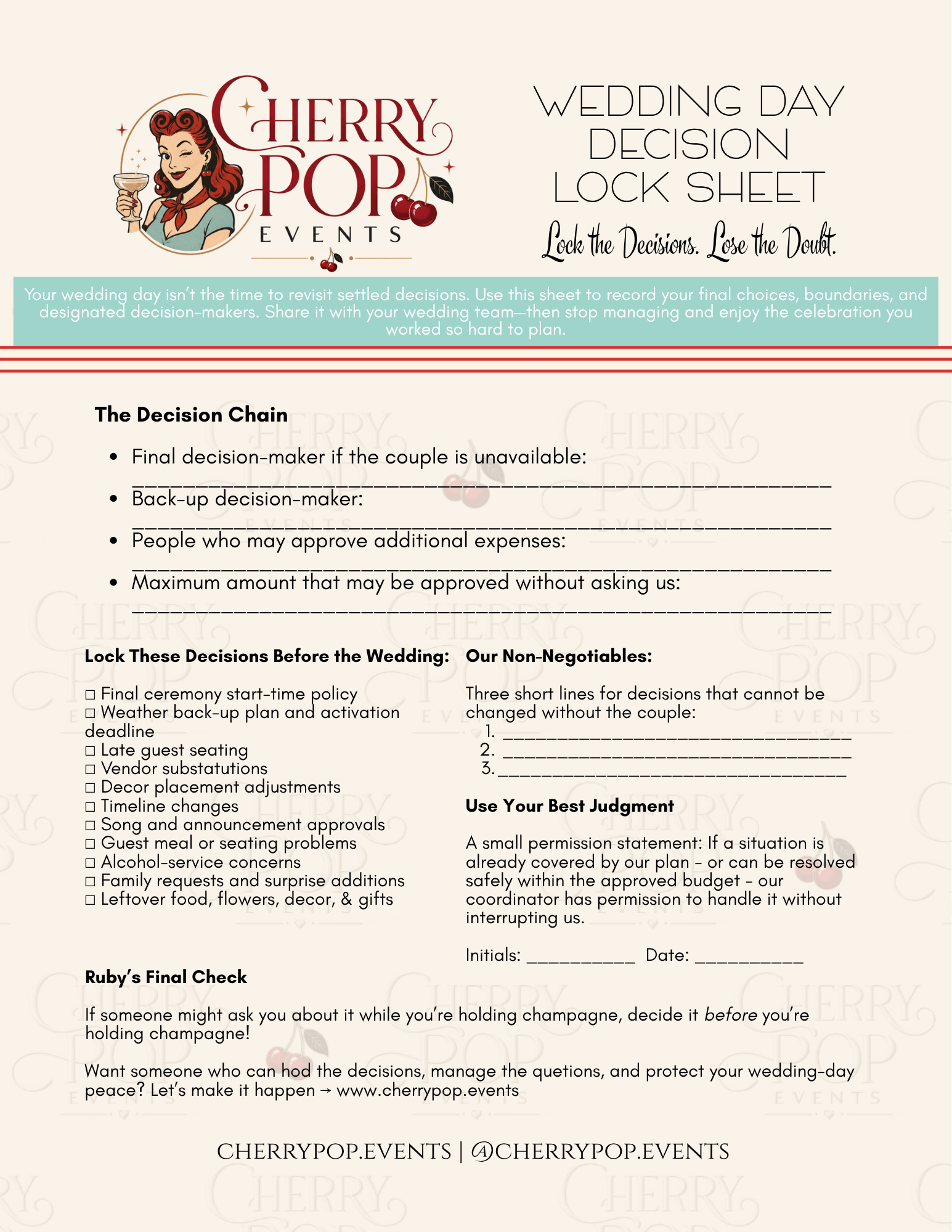
Having trouble centralizing all your communications and expectations? Download our Decision Matrix to help your planning!

Let Cherry Pop Events Connect the Whole Board
Cherry Pop Events wedding-day coordination is not limited to watching the clock on the day of the wedding.
I step into the plan before the event, gather the vendor details, reconcile the timelines, identify missing information, confirm responsibilities, distribute the final plan, and become the central point of contact for execution.
Your vendors remain experts in their work. I make sure their work connects.
If you want help holding the whole plan together, that’s what I do.
Visit cherrypop.events to schedule a consultation.
Hear More on The Pin-Up Planner
This week on The Pin-Up Planner, we are talking about why good vendors can still end up working from conflicting plans, what belongs in a final vendor packet, and how one clear communication chain protects the couple from becoming the wedding-day switchboard.

Leave a Reply